
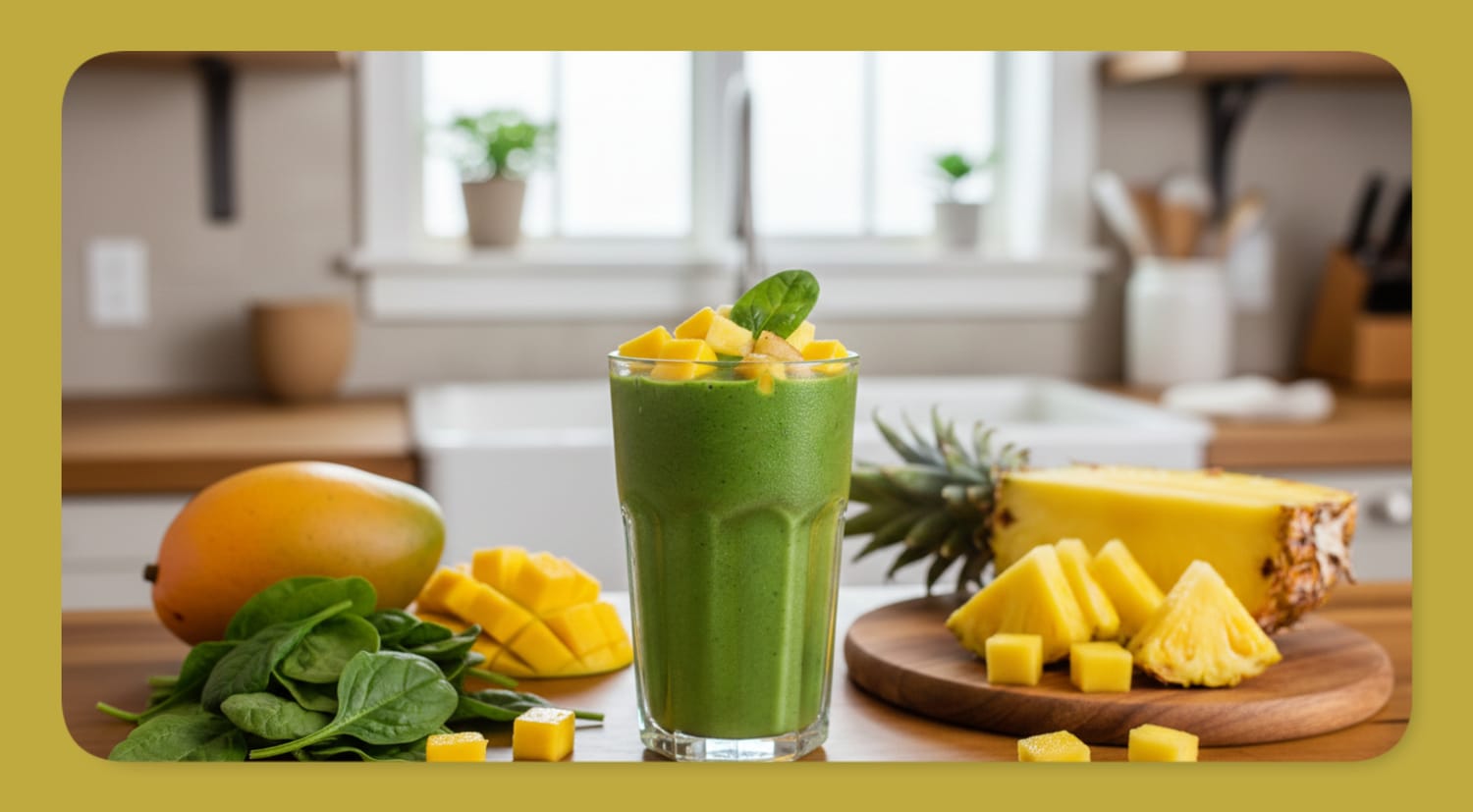
Energizing Green Smoothie: No Green Taste That Even Picky Eaters Love
The first sip hits your lips: sweet tropical mango, bright pineapple, and creamy banana. And you'd never guess you're drinking two full cups of spinach. This isn't one of those bitter, swampy green smoothies that tastes like you're eating your lawn. This is the smoothie that finally converts the skeptics, the one that makes you wonder why you've been avoiding greens for so long.
We've all been there: trying to get more vegetables into our diet, blending up a green smoothie with the best intentions, only to end up with something that tastes like grass clippings and regret. The problem with most green smoothies isn't the spinach itself, it's the ratio. Too many greens, not enough fruit to balance them out. Too much bitterness, not enough natural sweetness. The result? A smoothie you force down rather than actually enjoy, and then you give up on the whole green smoothie thing entirely.
That's exactly why I developed this recipe. I wanted all the incredible nutritional benefits of leafy greens (the vitamins, the minerals, the antioxidants) without any of the "healthy taste" that makes you grimace. After testing dozens of combinations, I found the golden ratio: enough spinach to power your morning, but so perfectly masked by tropical fruits that even the pickiest eaters (yes, even kids) genuinely love it. This smoothie delivers serious nutrition while tasting like a tropical vacation in a glass. It's filling enough to replace your breakfast, energizing enough to skip that second coffee, and simple enough to make on the busiest mornings.
What Makes This Green Smoothie Special
- Zero Green Taste: The combination of sweet mango, tangy pineapple, and creamy banana completely masks the spinach flavor. You get all the nutrition without any of the bitterness or "green" taste that usually comes with leafy greens.
- Naturally Energizing Without Caffeine: Packed with natural sugars from whole fruits, B vitamins from spinach, and complex carbs from banana, this smoothie provides sustained energy for hours—no coffee jitters, no mid-morning crash, just steady fuel for your day.
- Two Full Servings of Greens Hidden in Plain Sight: Each smoothie contains 2 cups of fresh spinach, which wilts down to barely anything in the blender but delivers a massive nutritional punch. You're getting more greens than most people eat in an entire day, all in one delicious glass.
- Perfectly Creamy Texture Without Dairy: The frozen banana creates a thick, milkshake-like consistency that feels indulgent and satisfying. No chalky protein powder texture, no watery disappointment, just smooth, creamy perfection.
- Ready in Under 5 Minutes: From pulling ingredients out of your freezer to drinking your smoothie, you're looking at less time than it takes to wait in a drive-thru line. Perfect for those mornings when you hit snooze one too many times.
Ingredients
Base Ingredients:
- 2 cups fresh spinach, packed (60g) - provides vitamins A, C, K, and iron without affecting taste
- 1 cup frozen mango chunks (165g) - delivers natural sweetness and creates creamy texture
- 1 cup frozen pineapple chunks (165g) - adds tropical brightness and digestive enzymes
- 1 medium banana, frozen (120g) - creates thickness and adds potassium and natural energy
- 1 cup coconut water (240ml) - hydrating base with natural electrolytes
- 1/2 cup orange juice (120ml) - enhances tropical flavor and adds vitamin C
Nutritional Boosters (Optional):
- 1 scoop vanilla protein powder (adds 20g protein)
- 1 tablespoon chia seeds (fiber and omega-3s)
- 1 tablespoon ground flaxseed (healthy fats)
- 1/4 avocado (extra creaminess and healthy fats)
- 1 teaspoon fresh ginger (immunity boost and zing)
For Extra Sweetness (Optional):
- 1 tablespoon honey
- 2-3 pitted Medjool dates
- 1/2 cup additional mango
Blending Instructions & Technique
A. Preparation:
If your banana and fruit aren't already frozen, peel and chop your banana into chunks, then freeze for at least 2 hours or overnight. Frozen fruit is the secret to achieving that thick, creamy texture without needing ice cubes that water down the flavor. You can also use fresh mango and pineapple, but the consistency will be thinner and less shake-like.
Rinse your fresh spinach thoroughly, even if it's pre-washed, and pat dry if you have time. Excess water on the leaves can make your smoothie slightly more diluted.
B. Blend Order & Layering:
- Add liquids first (coconut water and orange juice)
This prevents your blender blades from getting stuck and ensures everything blends smoothly from the start. Liquid at the bottom creates a vortex that pulls ingredients down toward the blades. - Add fresh spinach
The spinach should be completely submerged in the liquid. This is crucial for eliminating any green taste. When spinach blends with liquid first, it breaks down more completely before the frozen fruit gets involved. - Add frozen banana chunks
The banana acts as a bridge between the greens and the tropical fruits, adding creaminess and helping everything blend together. - Top with frozen mango and pineapple
Adding the densest frozen ingredients last allows them to gradually work their way down into the spinning vortex, creating the smoothest possible texture. - Add any boosters last
If using protein powder, chia seeds, or other add-ins, sprinkle them on top so they don't clump at the bottom.
C. Blending Technique:
Start your blender on LOW speed for 10-15 seconds. You'll hear it struggling a bit as it breaks down the frozen fruit, that's normal. The spinach should already be completely liquefied and bright green.
Increase to MEDIUM speed for another 10-15 seconds. The mixture will start to move more freely as the frozen fruit begins to break down.
Finish on HIGH speed for 30-45 seconds, or until the mixture is completely smooth with no visible spinach flecks or fruit chunks. You'll know it's ready when the blender motor sounds smooth and consistent rather than laboring. The color should be a beautiful vibrant green, almost neon, not dull or brownish.
If your blender is struggling, stop and use a tamper to push ingredients toward the blades, or add 2-3 tablespoons more liquid. Never let your blender strain for too long. It's better to stop, stir, and restart than to burn out the motor.
D. Finishing & Serving:
Check the consistency by stopping the blender and looking at the texture. The smoothie should coat the sides of the blender container and move slowly when you tilt it, thick like a milkshake, but still pourable. If you lift your blender lid and the smoothie is so thick it doesn't move at all, add 1-2 tablespoons of coconut water and blend for another 10 seconds.
Pour immediately into a chilled glass. The smoothie will start to separate slightly after 5-10 minutes, so it's best enjoyed right away for optimal texture and taste.
Texture & Consistency Guide
For Drinkable Smoothies:
Too Thin? Add: Another 1/2 frozen banana, 1/4 cup more frozen mango or pineapple, 2-3 ice cubes, or a handful of frozen cauliflower rice (won't affect taste)
Too Thick? Add: 2 tablespoons coconut water at a time, blend between additions. You can also use regular water, but coconut water maintains the tropical flavor profile better.
Ideal Consistency Indicators:
Perfect Drinkable Consistency: Should flow through a wide straw with gentle suction, but have enough body that it doesn't feel like juice. When you pour it, it should ribbon slightly rather than splash. The back of a spoon dipped in the smoothie should be evenly coated with a thick layer.
Color Check: Should be bright, vibrant green, almost kelly green or lime green, not olive or brownish. A dull color means you over-blended or didn't use enough frozen fruit.
Sound Test: When you stir it with a spoon, you should hear a thick, smooth swooshing sound, not a watery slosh.
Customization Matrix
Liquid Base Options:
- Tropical: Coconut water, coconut milk, pineapple juice, orange juice
- Creamy: Almond milk, oat milk, cashew milk, regular milk
- Light: Water, green tea (cooled), cucumber water
- Protein-Boost: Kefir, drinkable yogurt, protein shake
Greens Alternatives:
- Mild Flavor: Baby spinach (best for beginners), romaine lettuce
- Stronger Nutrition: Kale (remove stems), Swiss chard, mixed spring greens
- Hidden Veggies: Frozen zucchini (1/2 cup), frozen cauliflower rice (1/4 cup)
Tropical Fruit Swaps:
- Instead of Mango: Peaches, papaya, frozen passion fruit, mango-flavored sorbet
- Instead of Pineapple: More mango, peaches, or 1/2 cup orange segments
- Add Extra Tropical: Frozen passion fruit pulp, fresh lime juice (1 tablespoon), coconut flakes
Protein Boosters:
- Plant-Based: Vanilla protein powder (20g protein), hemp seeds (3g protein per tablespoon), almond butter (2 tablespoons = 7g protein)
- Dairy: Greek yogurt (1/2 cup = 10g protein), cottage cheese (1/4 cup = 7g protein), milk instead of coconut water
- Nut-Free: Sunflower seed butter, pumpkin seed butter, oat-based protein powder
Natural Sweeteners:
- Fruity: Extra banana (adds 1/2 cup), 2-3 pitted dates, 1/4 cup extra mango
- Liquid: 1 tablespoon honey, 1 tablespoon maple syrup, 1 tablespoon agave
- Whole Food: Frozen sweet potato (1/4 cup - surprisingly good!), ripe pear
Thickness Enhancers:
- Creamy: 1/4 avocado, 1/4 cup frozen cauliflower rice, 2 tablespoons oats
- Fibrous: 1 tablespoon chia seeds (let sit 5 minutes), 2 tablespoons ground flaxseed
- Frosty: More frozen banana, handful of ice cubes, frozen zucchini
Chef's Tips for Success
Freeze Your Fruit Properly: Spread banana chunks, mango, and pineapple on a parchment-lined baking sheet and freeze for 2 hours before transferring to freezer bags. This prevents them from clumping into one giant frozen mass that's impossible to break apart at 6 AM.
Always Use Frozen Banana: Fresh banana will make your smoothie thin and room-temperature. Frozen banana is what creates that thick, creamy, milkshake texture that makes this smoothie satisfying and filling.
Don't Skip the Pineapple: While mango provides sweetness, pineapple adds the bright, tangy notes that balance everything out and prevent the smoothie from tasting too flat or one-dimensional. The natural acidity also helps mask any potential green flavor.
Blend Greens with Liquid First: This is the most important tip for eliminating green taste. When you blend spinach with the liquid base before adding frozen fruit, it breaks down completely into tiny particles that your taste buds can't detect. If you add everything at once, you risk having small spinach chunks that create that "grassy" flavor.
Start with Less Liquid Than You Think: You can always add more liquid if your smoothie is too thick, but you can't take it away if it's too thin. Start with the recipe amounts, then add more only if needed. A thick smoothie is always better than a watery one.
Use Room Temperature Liquid: If your coconut water and orange juice come straight from the fridge, they're fine. But avoid using ice-cold liquid if your blender isn't very powerful—it makes frozen fruit even harder to blend and can strain your motor.
Best Consumed Immediately: This smoothie tastes incredible right out of the blender but will separate and oxidize (turn slightly brown) if left sitting. The natural enzymes in pineapple speed up this process. If you need to store it, keep it in an airtight container in the fridge for up to 24 hours and shake vigorously before drinking.
Nutritional Benefits Section
This green smoothie delivers serious nutrition without tasting like health food. Here's what makes it a powerhouse breakfast or energy-boosting snack:
High Vitamin Content for Sustained Energy: Just 2 cups of spinach provides over 300% of your daily vitamin K, 56% of vitamin A, and 47% of folate. Unlike caffeine that gives you a quick spike and crash, these B vitamins support steady energy production at the cellular level throughout your morning.
Natural Electrolytes for Hydration: Coconut water contains potassium, magnesium, and sodium, natural electrolytes that keep you hydrated far better than plain water. Combined with the potassium in banana (422mg), this smoothie rivals commercial sports drinks but without added sugars or artificial ingredients.
Digestive Enzymes from Pineapple: Pineapple contains bromelain, a natural enzyme that aids protein digestion and reduces bloating. This is especially helpful if you add protein powder to your smoothie or drink it alongside your breakfast.
Antioxidants for Immune Support: Mango is rich in beta-carotene and vitamin C (67mg per cup), while spinach provides lutein and zeaxanthin. These antioxidants fight free radicals, support immune function, and promote healthy skin, making this more than just a breakfast, it's a beauty food.
Fiber for Lasting Fullness: With 7 grams of dietary fiber from the fruit and spinach, this smoothie keeps you satisfied until lunch. The fiber also supports digestive health and helps stabilize blood sugar levels, preventing the mid-morning energy crash.
Zero Added Sugar: Every gram of sugar in this smoothie comes from whole fruits, which means it's paired with fiber, vitamins, and minerals that slow absorption. Compare that to a store-bought green smoothie, which often contains 30-40g of added sugars from juice concentrates or sweeteners.
Macro Breakdown:
Why This Matters:
This nutritional profile makes the smoothie ideal for active mornings when you need sustained energy. The high carbohydrate content from natural fruit sugars provides immediate energy, while the fiber ensures gradual release over 2-3 hours. The low fat content means it digests quickly, so you won't feel heavy or sluggish. For weight management, the high volume and fiber content create satiety with relatively moderate calories—you feel full and satisfied without consuming a huge caloric load. Parents will love that this delivers more vitamins and minerals than most kids get in an entire day, all disguised in a sweet, tropical smoothie they'll actually ask for.
Best Blender Types & Equipment
High-Speed Blenders (Ideal):
Vitamix, Blendtec, Ninja Professional - These powerhouse blenders pulverize frozen fruit and leafy greens into silk-smooth perfection in under 60 seconds. The high wattage means no chunks, no green specks, and no straining your motor.
Best for: Daily smoothie makers, anyone serious about eliminating ALL green taste, smoothie bowls, and processing frozen ingredients regularly
Price range: $200-$500+
Standard Blenders (Works Great):
Most kitchen blenders (Oster, Hamilton Beach, KitchenAid) These absolutely work for this recipe. You might need to blend 15-20 seconds longer and let frozen fruit thaw for 5 minutes before blending, but you'll still get excellent results.
Tip: Cut your frozen banana into smaller chunks (1-inch pieces), add liquid first, and start on low speed. If your blender struggles, stop and stir with a spoon to redistribute ingredients, then continue blending.
Best for: Occasional smoothie makers, budget-conscious cooks, anyone with a standard blender already
Personal/Bullet Blenders (Convenient):
NutriBullet, Magic Bullet, Ninja Personal Perfect for single servings and ideal for this recipe since it naturally makes 1-2 servings. The compact size means less cleanup and easier storage.
Tip: Don't fill past the MAX line. These smaller blenders actually work better with frozen ingredients because everything stays closer to the blades. You may need to pulse several times and shake the container between pulses.
Best for: Single-serving smoothies, small kitchens, grab-and-go breakfasts, dorm rooms
No Blender? No Problem:
Immersion/stick blender - Can work for this smoothie if you use fresh fruit instead of frozen and blend in a deep, narrow container. Texture won't be as smooth, but it's totally drinkable.
Food processor - Use the chopping blade and pulse frozen ingredients until finely chopped, then add liquids and process until relatively smooth. Won't be perfectly creamy, but definitely acceptable.
Other Helpful Tools:
- Wide reusable straws - Essential for thick smoothies; regular straws collapse under the pressure
- Mason jars with lids - Perfect for storage and also double as drinking glasses
- Blender tamper - Comes with high-speed blenders; pushes ingredients toward blades without stopping
- Portion-sized freezer bags - For making smoothie packs that you can grab and blend in seconds
Storage, Prep & Serving
Immediate Serving:
This smoothie hits peak deliciousness within the first 15 minutes of blending. The texture is perfectly smooth, the color is vibrant, and the flavors are bright and fresh. Pour into a chilled glass if you want to keep it cold longer, or drink straight from the blender container if you're in a rush.
For the best experience, use a wide reusable straw or just sip directly from the glass. The thick consistency makes it satisfying to drink slowly.
Short-Term Storage:
Refrigerator: Store in an airtight container (mason jar with lid works perfectly) for up to 24 hours. The smoothie will naturally separate with the fiber settling to the bottom and liquid rising to the top. This is completely normal and doesn't mean it's gone bad. Give it a vigorous shake or quick re-blend before drinking.
Note: The color will oxidize slightly, turning from bright green to a more olive or brownish-green after a few hours. This is due to the natural enzymes in pineapple and doesn't affect taste or nutrition. If appearance matters (like for meal prep), add a squeeze of fresh lemon juice which slows oxidation.
Make-Ahead Smoothie Packs:
This is a game-changer for busy mornings and the method I use most often:
How to prep: Portion 2 cups spinach, 1 cup frozen mango, 1 cup frozen pineapple, and frozen banana chunks into a gallon-sized freezer bag. Press out all the air, seal, and label with "Green Smoothie + 1.5 cups liquid."
Storage: Freeze for up to 3 months without any loss of quality or nutrition.
Morning routine: Dump entire contents of bag into blender, add 1.5 cups coconut water and orange juice, blend for 60 seconds, and you're done. Literally 2 minutes from freezer to finished smoothie.
Freezing Finished Smoothies:
Ice cube method: Pour leftover smoothie into ice cube trays and freeze. Pop out 6-8 cubes and blend with 1/4 cup liquid for a quick frosty smoothie, or add to other smoothies for an extra nutrition boost.
Freezer bag method: Pour smoothie into a quart-sized freezer bag, press flat, and freeze laying flat on a baking sheet. Breaks apart easily for portion control and thaws quickly.
Storage time: Up to 1 month in the freezer
How to use: Thaw overnight in the fridge and shake well, or break into chunks and re-blend with a splash of liquid for a thick, frosty texture.
Meal Prep Benefits:
When you prep 5-7 smoothie packs on Sunday, you're giving yourself the gift of 5-7 mornings where breakfast is done in 2 minutes. No thinking required, no measuring half-asleep, no forgotten produce rotting in your crisper drawer. You're saving at least 10 minutes every single morning, which adds up to nearly an hour of time saved per week. Plus, you're guaranteeing yourself a nutritious breakfast even on your most chaotic days, which means no more drive-thru stops or skipped meals.
Serving Suggestions & Occasions
Best Times to Enjoy:
- Breakfast on-the-go - Drink in the car, at your desk, or while getting kids ready for school. The thick consistency means it won't spill easily, and it's filling enough to keep you satisfied until lunch.
- Post-workout recovery - The natural sugars replenish glycogen stores, potassium prevents cramping, and if you add protein powder, you're getting optimal muscle recovery nutrition in one convenient glass.
- Afternoon energy boost - Skip the 3 PM coffee and sugar crash cycle. This smoothie provides natural energy that lasts without jitters or crashes, plus the hydration factor helps combat that afternoon sluggishness.
- Pre-workout fuel - The quick-digesting natural sugars give you energy without feeling heavy, and the hydrating coconut water preps your body for exercise.
- Kid-friendly after-school snack - They'll think they're getting a treat (it tastes like a tropical milkshake), but you'll know they're getting two servings of vegetables and a full serving of fruit.
Perfect Pairings:
With: Whole grain toast with almond butter, hard-boiled eggs, protein muffin, handful of raw almonds, overnight oats
As a meal replacement: Add 1 scoop protein powder, 2 tablespoons almond butter, and 1 tablespoon chia seeds to boost it to 400+ calories with 25g+ protein—now it's a complete meal that will keep you full for 4-5 hours.
For a complete breakfast plate: Pair with scrambled eggs and avocado toast for a balanced meal with protein, healthy fats, complex carbs, and tons of micronutrients.
Make It a Complete Meal:
To transform this smoothie from a snack into a full meal replacement:
- Add protein: 1 scoop vanilla protein powder (20g), 1/2 cup Greek yogurt (10g), or 2 tablespoons nut butter (8g)
- Include healthy fats: 1/4 avocado, 1 tablespoon almond butter, 1 tablespoon chia seeds, or 2 tablespoons hemp seeds
- Increase volume: Add 1/4 cup oats (blended in for thickness and staying power) or extra frozen banana
With these additions, you're looking at a 400-500 calorie smoothie with 20-30g protein, 10-15g healthy fats, and enough fiber to keep you satisfied until your next meal. This is the exact formula I use when I know I won't have time to eat again for 4-5 hours.
Final Thoughts
The beauty of this green smoothie isn't just that it tastes like tropical paradise instead of a lawn mower, it's that it finally makes vegetables approachable for people who've been avoiding them. No more forcing down bitter, grassy drinks because you know they're good for you. No more hiding your grimace while pretending it tastes fine. This smoothie genuinely tastes delicious while delivering nutrition that rivals a full salad.
For busy parents, this is your secret weapon. You can get more vegetables into your kids with this single smoothie than they'd eat voluntarily in an entire week, and they'll be asking you to make it again. For health-conscious professionals rushing out the door, you're getting a genuinely nutritious breakfast that requires minimal effort and zero cleanup beyond rinsing a blender. For anyone trying to eat healthier but struggling with the taste of vegetables, this proves that healthy food doesn't have to taste like punishment.
The best part? Once you've mastered this base recipe, the customization options are endless. Swap the tropical fruits for berries, add protein powder for post-workout recovery, throw in some nut butter for staying power, or boost it with superfoods. The formula stays the same (enough greens to matter, enough fruit to mask them completely) but the possibilities are limitless.
Your mornings just got easier, healthier, and a whole lot more delicious. And because this recipe is so flexible, you can make it exactly what you need it to be: quick breakfast, workout fuel, afternoon pick-me-up, or sneaky vegetable delivery system for picky eaters. Make it your own with the customization options above, and don't be surprised when this becomes the recipe you make so often you don't even need to measure anymore.
Ready to join the green smoothie revolution? Let's talk about some common questions that come up when people make this for the first time.
FAQ Section
Can I use fresh fruit instead of frozen?
Yes, but your smoothie will be much thinner and less creamy. If using fresh fruit, you'll need to add 1 cup of ice cubes to get that thick, milkshake texture. Frozen fruit is really the secret to achieving that satisfying, spoon-coating consistency without diluting the flavor. If you only have fresh fruit available, freeze it yourself for at least 2 hours before blending. This works just as well as store-bought frozen fruit.
Why can't I taste the spinach at all?
The tropical fruits completely mask the spinach through a combination of factors. First, spinach is actually one of the mildest leafy greens with almost no bitter compounds when fresh. Second, the high sugar content and bright acidity of mango, pineapple, and orange juice overwhelm your taste buds so they can't detect the subtle earthiness of spinach. Third, by blending the spinach with liquid first, it breaks down into such tiny particles that your taste buds never encounter a concentrated pocket of "green" flavor. The result is pure tropical fruit flavor with hidden nutrition.
How can I make this higher in protein?
The easiest way is to add 1 scoop of vanilla or unflavored protein powder, which adds about 20g of protein without significantly changing the taste. You can also substitute 1/2 cup Greek yogurt for half the coconut water (adds 10g protein), blend in 2 tablespoons of almond or peanut butter (adds 7-8g protein), or use regular milk instead of coconut water. If you want to keep it vegan, hemp seeds add 3g protein per tablespoon with a mild, nutty flavor that complements the tropical fruits.
My smoothie separated in the fridge—is it still good?
Absolutely! Separation is completely normal and happens because the fiber settles to the bottom while the liquid rises to the top. This is actually a good sign because it means you're using whole, real ingredients without stabilizers or thickeners. Just give it a really vigorous shake for 15-20 seconds before drinking, or pour it back into the blender and pulse for 10 seconds to re-emulsify everything. The taste and nutrition are exactly the same.
Can I make this without a high-speed blender?
Yes! Any blender will work for this recipe, though you might need a few adjustments. With a standard blender, let your frozen fruit sit at room temperature for 5 minutes before blending, cut your frozen banana into smaller chunks, and blend for an extra 20-30 seconds. Start on low speed and gradually increase to high. If it's struggling, stop and stir with a spoon to redistribute ingredients, then continue blending. You might not get quite as silky-smooth a texture, but it will still taste great and be totally drinkable.
How do I make this smoothie thicker without adding calories?
The best zero-calorie thickener is frozen cauliflower rice—add 1/4 to 1/2 cup and you'll never taste it, but it creates incredible thickness. Frozen zucchini works similarly. Ice cubes will thicken it but also dilute the flavor, so use them sparingly. If you don't mind a few extra calories, frozen banana is your best friend (adds thickness and 53 calories per half banana). You can also add 1-2 tablespoons of chia seeds and let the smoothie sit for 5 minutes—they'll absorb liquid and create a thicker gel-like consistency for only 60 calories.
Is this smoothie OK for kids?
This is actually one of the best smoothies for kids because it tastes like a sweet tropical treat while delivering serious nutrition. The spinach is completely undetectable, so even the pickiest vegetable-avoiders will drink it happily. The natural sugars from fruit provide energy without the crash that comes from added sugars, and there are no artificial ingredients, dyes, or preservatives. Kids typically love the bright green color and think it's fun to drink something that looks so unusual but tastes so good. Just be aware that this is naturally high in fiber, so start with smaller portions (8 oz instead of 16 oz) if your child isn't used to eating much produce.
Can I make this the night before for a quick morning grab?
You can, though it won't be quite as perfect as freshly blended. If you're making it the night before, blend everything except the ice, store in an airtight container in the fridge, and give it a vigorous shake in the morning before drinking. The texture will be slightly less thick and the color will oxidize to more of an olive green, but the taste and nutrition remain intact. A better overnight strategy is to prep a smoothie pack (all ingredients except liquid in a freezer bag) so you can blend fresh in the morning in just 2 minutes.
Glossary of Key Terms
The liquid foundation that determines your smoothie's final consistency and flavor profile. In this recipe, coconut water provides hydration and natural sweetness while orange juice adds brightness and vitamin C. Using too much liquid creates a thin, juice-like texture, while too little makes blending difficult.
A natural enzyme found in pineapple that aids in protein digestion and reduces inflammation. This is why pineapple smoothies can feel easier on your stomach, especially after workouts or when combined with protein powder. It's also why pineapple can make your tongue tingle if you eat too much.
The secret ingredient that creates creamy, milkshake-like texture without dairy or added thickeners. When frozen and blended, banana's starches break down into a smooth, almost custard-like consistency. Always freeze banana in chunks rather than whole for easier blending and more consistent results.
A blended drink that contains leafy greens (spinach, kale, chard) combined with fruits and liquids. The key to a good green smoothie is balancing the greens with enough sweet ingredients that the flavor is enjoyable rather than bitter or grassy. Beginners should always start with mild spinach rather than stronger-flavored kale.
Professional-grade blenders with motors rated at 1000+ watts that can pulverize frozen ingredients, ice, and fibrous vegetables into completely smooth textures. Brands like Vitamix and Blendtec are the gold standard, but many mid-range options now offer similar power. The higher speed creates smoother smoothies with no detectable chunks or fiber bits.
Minerals like potassium, magnesium, and sodium that regulate hydration and muscle function in your body. Coconut water contains all three naturally, making it superior to plain water for post-workout smoothies or hot weather hydration. You're getting electrolyte benefits without the artificial ingredients and added sugars found in commercial sports drinks.
The natural process where fruits and vegetables turn brown when exposed to air, similar to how a cut apple browns. In smoothies, oxidation causes the bright green color to fade to olive or brownish-green after a few hours. While it looks less appealing, oxidation doesn't significantly affect nutrition or taste. Adding citrus juice slows this process.
A meal-prep strategy where you portion all smoothie ingredients (except liquid) into a single freezer bag, making morning smoothies as easy as dump-and-blend. These packs eliminate measuring, reduce morning decision fatigue, and ensure you always have healthy options ready. They typically last 2-3 months in the freezer without freezer burn.
Nutrient-dense ingredients like chia seeds, hemp hearts, flaxseed, spirulina, or maca powder that you add in small amounts for concentrated nutritional benefits. While not necessary for a healthy smoothie, these boosters can increase protein, omega-3s, fiber, or specific vitamins and minerals without significantly changing taste when used in appropriate amounts.
Fruits typically grown in warm climates that have naturally high sugar content and bright, vibrant flavors. Mango, pineapple, papaya, and passion fruit are classic examples. In smoothies, tropical fruits tend to have stronger flavors than berries, making them ideal for masking the taste of vegetables or other nutritious ingredients.
The swirling motion created inside a blender when ingredients are added in the right order and proper proportions. A good vortex pulls ingredients down toward the blades continuously, creating smooth, even blending. If your blender isn't creating a vortex (ingredients just spinning at the top), you either have too little liquid or too much frozen material packed too tightly.
Share Your Success!
What's your biggest challenge with green smoothies—the taste, the texture, or just finding time to make them? I'd love to hear how this recipe worked for you, especially if you're someone who's been avoiding greens because of the taste factor. Did the tropical fruits completely mask the spinach like I promised, or could you still detect a hint of green?
If you tried any of the customization options—protein powder, different fruits, or sneaky veggie add-ins like cauliflower—drop a comment and let me know what combinations you loved. I'm always testing new variations and your feedback helps me create even better recipes.
Pin this recipe to your Pinterest smoothie board so you can find it again on those busy mornings when you need healthy breakfast inspiration! There's nothing worse than remembering a great recipe but not being able to find it again. Save it now while you're thinking about it, and your future self will thank you.
For more energizing smoothie recipes, veggie-packed breakfast ideas, and meal prep strategies that actually work for busy lives, follow me on Pinterest! I share new recipes weekly, and I love featuring reader creations in my stories—tag me in your green smoothie photos and you might see your breakfast on my feed!
Now go blend up that gorgeous green goodness and enjoy every tropical, energizing sip. Your body will thank you, even if your taste buds think you're just drinking dessert for breakfast.
More Delicious Smoothies to Try
Affiliate Disclosure
This page may contain affiliate links. This means that if you click on one of these links and make a purchase, I may receive a small commission at no additional cost to you. This helps support the blog and allows me to continue creating free content. I only recommend products or services that I use personally and believe will add value to my readers. Your support is appreciated!
Created with ©simplyhealthynews