
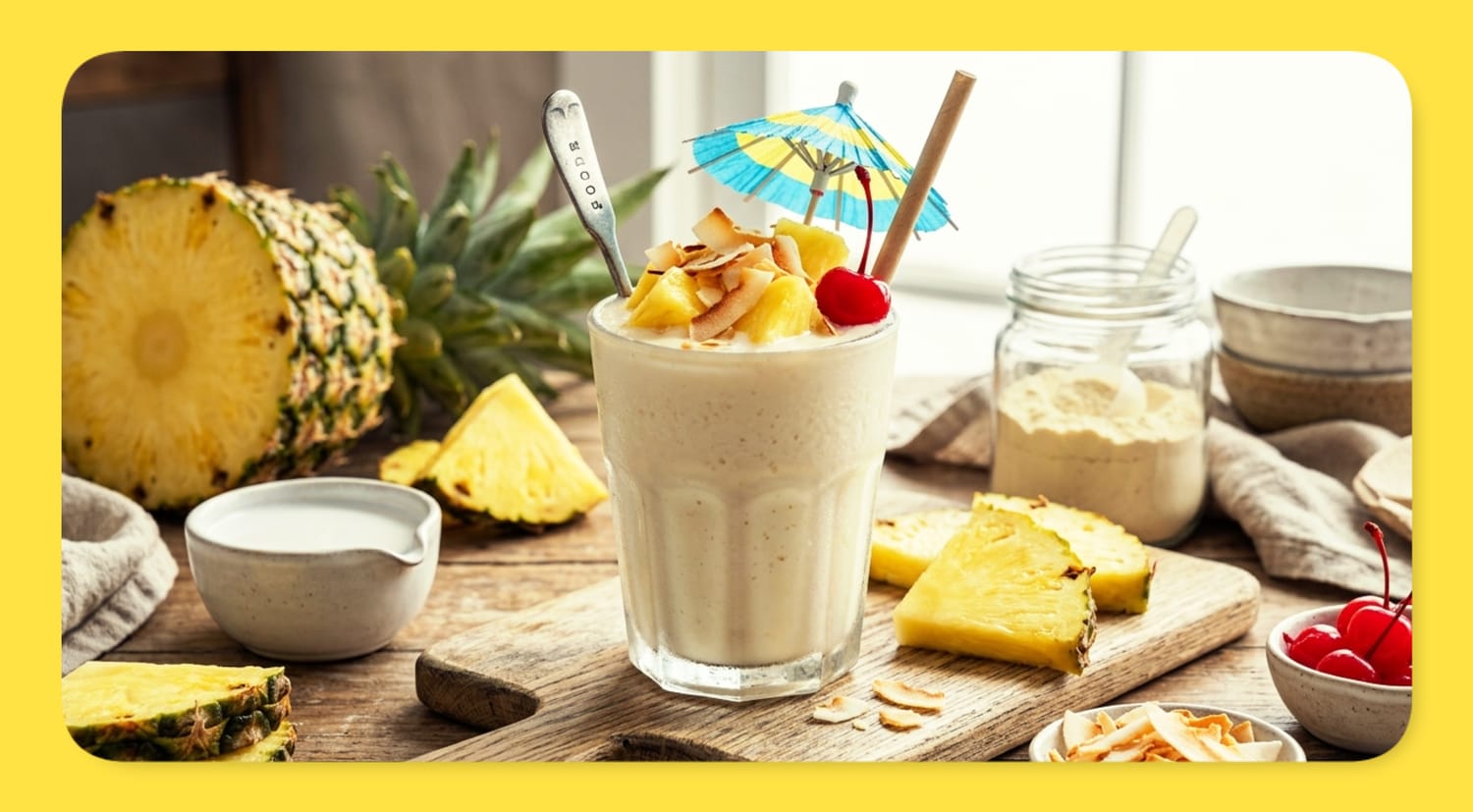
Tropical Piña Colada Protein Smoothie
A High-Protein Vacation in Every Glass
Close your eyes. The glass is cold against your fingers, beaded with condensation like a drink just handed to you poolside. You take the first sip and the flavors hit in waves. Bright, tangy pineapple breaks through first, sunlit and sharp, then immediately melts into a cloud of rich, creamy coconut that coats your entire palate. There's a hint of vanilla warmth in the background, something almost caramelized, and the whole thing is so thick and frosty that your brain genuinely hesitates between "smoothie" and "frozen cocktail." Except there's no rum here. No added sugar crash. Just 30 grams of clean protein hiding behind one of the most craveable flavor combinations on earth, waiting to rebuild your muscles and carry you through the rest of your day.
This recipe happened because of a gym problem. I'd been cycling through the same three post-workout shakes for months: chocolate protein with water, vanilla protein with water, and the occasional desperate vanilla protein with almond milk. They were functional. They hit my macros. And I dreaded every single one of them. One afternoon after a particularly brutal leg day, I stood in front of my blender, looked at the sad scoop of vanilla protein powder on the counter, and decided I was done settling. I had frozen pineapple in the freezer from a smoothie bowl I'd made the week before. A can of coconut milk in the pantry. A bag of unsweetened coconut flakes I'd bought for reasons I couldn't remember. I threw everything together, blended it, and the sound I made after that first sip was loud enough to concern my neighbor.
That was the beginning of the end of boring protein shakes in my house. This piña colada smoothie has traveled with me in a shaker bottle to the gym, appeared at post-workout brunches, been doubled and poured into a pitcher for Fourth of July parties, and been requested by name more times than any other recipe I've ever created. People who say they don't like protein powder ask for seconds. People who say they don't like healthy food ask for the recipe. It's the smoothie that proves fitness nutrition and genuine deliciousness don't have to exist in separate universes.
What Makes This Smoothie Special
Ingredients
🛒 What You'll Need
- 1 cup (165g) frozen pineapple chunks
- 1 scoop (30g) vanilla protein powder (whey or plant-based)
- 3/4 cup (180ml) full-fat coconut milk (from carton, not canned)
- 2 tablespoons (10g) unsweetened coconut flakes
- 1 small frozen banana (about 75g), or half a medium frozen banana
- 1 tablespoon (15ml) pure maple syrup (optional, adjust to taste)
- 1 teaspoon (5ml) pure vanilla extract
- 1/4 teaspoon (1g) ground turmeric (optional, for color and anti-inflammatory boost)
- Pinch of fine sea salt
- 4 to 5 ice cubes
- Squeeze of fresh lime juice (about 1 teaspoon)
Blending Instructions and Technique
📝 Prep
Keep your pineapple and banana frozen solid until the moment you blend. The thick, frosty, almost frozen-cocktail texture of this smoothie depends entirely on using fruit that hasn't begun to thaw. If your pineapple chunks are stuck together in a large clump, break them apart with a butter knife or let the bag sit on the counter for just 2 to 3 minutes, long enough to separate the pieces but not long enough to soften them.
If using a banana that was frozen whole, break it into 2 to 3 pieces before adding it to the blender. A whole frozen banana is difficult for many blenders to handle in one piece.
Give your coconut flakes a quick visual check. You want unsweetened, dried coconut flakes or shredded coconut, not the sweetened baking variety that's coated in sugar. The unsweetened version has a cleaner, more naturally tropical flavor and keeps the sugar content of the smoothie under control.
📊 Blend Order
- Pour the coconut milk into the blender first. Liquid on the bottom ensures the blades catch immediately and creates the vortex that pulls frozen ingredients downward into the blend zone.
- Add the vanilla extract, maple syrup if using, lime juice, ground turmeric if including, and the pinch of salt.
- Drop in the coconut flakes and the protein powder.
- Add the frozen pineapple chunks.
- Place the frozen banana pieces on top.
- Add ice cubes last.
⚡ Technique
Pulse 4 to 5 times to break up the frozen fruit and begin incorporating the protein powder into the liquid. Pineapple chunks are dense and fibrous, so a few initial pulses prevent them from locking up above the blades in a frozen mass.
Switch to high speed and blend for 50 to 60 seconds until the smoothie is uniformly creamy with no visible pineapple fiber strands, protein powder clumps, or coconut flake pieces. Pineapple has a fibrous core and stringy texture that requires a bit more blending time than softer fruits like berries or mango. Don't rush this step.
Stop the blender and check the consistency. Look for any white streaks (unblended protein powder) or pale spots of coconut flake. If you see either, scrape down the sides with a spatula and blend on high for another 10 to 15 seconds.
The finished smoothie should be a gorgeous pale golden-yellow, slightly opaque from the coconut milk and protein powder, with a thick, pourable consistency similar to a melted frozen cocktail. If you included the turmeric, the color will lean more toward warm gold.
Taste before pouring. Pineapple sweetness varies dramatically between brands and batches. Some frozen pineapple is bracingly tart while other bags are candy-sweet. Adjust maple syrup up or down by a teaspoon. The lime juice should be undetectable as a distinct flavor but should make the pineapple taste brighter and more alive. If the smoothie tastes flat, add another small squeeze of lime.
🎨 Finishing
Pour into a tall glass or an insulated tumbler. For a tropical presentation worthy of a beach bar, garnish with a wedge of fresh pineapple perched on the rim, a sprinkle of toasted coconut flakes across the surface, and a paper umbrella if you're feeling festive. A light dusting of ground cinnamon or a single mint leaf adds a polished finishing touch.
If you're taking this to the gym or on the go, pour into a shaker bottle or insulated bottle with a secure lid. It travels well for up to 45 minutes before the texture begins to thin.
Serve immediately for the coldest, thickest, most tropical experience.
Texture and Consistency Guide
🥤 For a Drinkable Smoothie
This recipe produces a thick drinkable smoothie, denser than a typical juice-bar blend but thinner than a milkshake. It moves through a wide straw with a satisfying pull. If it comes out thicker than you'd like, add coconut milk 1 tablespoon at a time, blending briefly after each addition, until you reach your preferred consistency.
If your smoothie is too thin:
- Add 3 to 4 more ice cubes and blend for 10 seconds
- Add another quarter of a frozen banana
- Blend in 1 tablespoon of chia seeds and let the smoothie rest for 2 to 3 minutes before stirring
- Add an extra tablespoon of coconut flakes and blend for 15 seconds (they absorb liquid and add body)
- Blend in 1 tablespoon of coconut cream scooped from the top of a chilled can of full-fat coconut milk
🥣 For a Smoothie Bowl
To transform this into a thick, spoonable tropical bowl, make these changes:
- Reduce the coconut milk to 1/3 cup (80ml)
- Increase frozen pineapple to 1 and 1/4 cups (205g)
- Add 5 to 6 ice cubes
- Use a fully frozen banana (do not let it soften at all)
- Blend using short pulses with a tamper tool, or stop and stir with a spatula between bursts
The goal is a soft-serve ice cream consistency that holds a spoon upright.
🏝️ Layering (For Bowls)
Scoop the thick smoothie base into a wide coconut shell or shallow bowl for the full tropical effect. Arrange toppings to evoke a beach vacation:
Customization Matrix
💧 Liquid Swaps
| Original | Swap Option | Flavor/Texture Change |
|---|---|---|
| Full-fat coconut milk (carton) | Light coconut milk (carton) | Slightly thinner, fewer calories, still tropical flavor |
| Full-fat coconut milk (carton) | Canned coconut milk (full-fat, shaken) | Much richer, thicker, higher calories, intense coconut |
| Full-fat coconut milk (carton) | Coconut water | Much lighter, thinner, more hydrating, less creamy |
| Full-fat coconut milk (carton) | Oat milk | Creamier neutral base, loses some coconut intensity |
| Full-fat coconut milk (carton) | Almond milk (unsweetened) | Lighter body, nutty undertone, mild flavor |
💪 Protein Swaps
| Original | Swap Option | Flavor/Texture Change |
|---|---|---|
| Vanilla protein powder (whey) | Vanilla plant-based protein powder | Dairy-free option, may be slightly grittier, check for pea protein aftertaste |
| Vanilla protein powder | Unflavored collagen peptides | No flavor change, thinner texture, blends invisibly, not suitable for vegans |
| Vanilla protein powder | Coconut-flavored protein powder | Doubles down on coconut flavor, check sugar content |
| Vanilla protein powder | Vanilla casein protein | Thicker, creamier texture, slower-digesting for sustained fullness |
| Vanilla protein powder | Silken tofu (1/2 cup / 125g) | Whole-food plant protein, ultra-creamy, neutral flavor, adds approximately 10g protein |
| Vanilla protein powder | Cottage cheese (1/2 cup / 115g) | Very high protein, tangy, blends smooth in powerful blenders, adds 14g protein |
🍯 Sweetener Swaps
| Original | Swap Option | Flavor/Texture Change |
|---|---|---|
| Maple syrup | Raw honey | Slightly floral sweetness, thicker, complements tropical flavors well |
| Maple syrup | Coconut sugar (dissolved in milk first) | Deeper, caramel-like sweetness, keeps the coconut theme consistent |
| Maple syrup | 2 pitted Medjool dates | Rich caramel depth, adds fiber, blends smooth when frozen or soaked |
| Maple syrup | Agave nectar | Light, clean sweetness, dissolves easily in cold liquids |
| Maple syrup | Omit entirely | Pineapple and banana provide substantial natural sweetness, works well if fruit is ripe |
🧊 Thickness/Texture Swaps
| Original | Swap Option | Flavor/Texture Change |
|---|---|---|
| Frozen banana | 1/3 cup (50g) frozen mango chunks | Tropical twist, slightly less creamy, adds more tropical complexity |
| Frozen banana | 1/3 cup (50g) frozen avocado | Ultra-creamy, healthy fats, color shifts slightly green, virtually no flavor |
| Frozen banana | 1/3 cup (50g) frozen cauliflower rice | Lower sugar, neutral flavor, lighter body, add extra sweetener to compensate |
| Coconut flakes | Coconut butter (1 tablespoon) | Richer, more concentrated coconut flavor, smoother texture |
| Coconut flakes | Shredded coconut (sweetened) | Sweeter, moister, reduce or omit maple syrup if using |
🚀 Booster Swaps
| Booster | Amount | Benefit |
|---|---|---|
| MCT oil | 1 tablespoon (14g) | Quick energy from coconut-derived fats, supports ketone production |
| Spirulina | 1/2 teaspoon (1.5g) | Nutrient-dense superfood, will turn smoothie green, mild seaweed taste |
| Maca powder | 1 teaspoon (3g) | Malt-like warmth, energy and hormone support, adaptogenic |
| Creatine monohydrate | 5g (1 teaspoon) | Strength and performance support, flavorless, dissolves completely |
| Glutamine powder | 5g (1 teaspoon) | Gut health and muscle recovery, tasteless, dissolves easily |
| Fresh ginger (grated) | 1/2 teaspoon (2g) | Warming digestive support, anti-inflammatory, subtle spice |
| Ground turmeric (already optional in recipe) | 1/4 teaspoon (1g) | Anti-inflammatory curcumin, warm golden color, pairs with pineapple |
| Frozen acai packet | 1/2 packet (50g) | Antioxidants, creates a purple-gold color, adds berry depth |
Chef's Tips for Success
Nutritional Benefits
This piña colada smoothie isn't just a tropical escape for your taste buds. It's engineered to support your body during one of its most demanding windows, the post-workout recovery period, while delivering sustained nutrition that keeps you fueled for hours.
📊 Macro Breakdown
| Nutrient | Amount |
|---|---|
| Calories | 385 |
| Protein | 30g |
| Carbohydrates | 40g |
| Fiber | 5g |
| Fat | 12g |
| Sugar | 24g (primarily naturally occurring from pineapple and banana) |
🌟 Key Nutritional Benefits
Why This Matters
The 30 to 60 minutes after a workout are often called the "anabolic window," and while the science has become more nuanced over the years (the window is likely wider than originally believed), there's still strong evidence that consuming protein and carbohydrates relatively soon after training supports better recovery outcomes. The problem is that most people reach for either a plain protein shake that tastes like obligation or a high-sugar smoothie that spikes blood sugar and crashes energy an hour later. This piña colada smoothie threads the needle perfectly. It delivers the protein and carbohydrate ratio that exercise science supports, wrapped in anti-inflammatory pineapple and easily digestible coconut fats, all in a format that tastes like you're on vacation. When your recovery nutrition is something you genuinely look forward to, you're far more likely to consume it consistently, and consistency is what drives real results over time.
Best Blender Types and Equipment
🔥 High-Powered Blenders (Vitamix, Blendtec, Ninja Professional)
This recipe performs beautifully in a high-powered blender. The fibrous texture of pineapple, which can leave stringy bits in lesser machines, gets completely annihilated in 45 to 50 seconds on high speed. Coconut flakes are pulverized into the base, adding creaminess and body without any detectable texture. If you own a Vitamix or Blendtec, this is a straightforward one-step blend with no special technique needed.
⚡ Mid-Range Blenders (NutriBullet, Ninja Personal, Hamilton Beach)
These handle the recipe well with a small strategic adjustment. Blend the coconut milk, coconut flakes, protein powder, and liquid ingredients together first for 15 seconds to break down the coconut flakes and dissolve the protein powder. Then add the frozen pineapple, banana, and ice, and blend on high for 45 to 55 seconds. This two-step approach ensures the coconut flakes are fully integrated before the blender has to work through the frozen fruit, preventing the motor from straining.
NutriBullet personal blenders are especially effective here because their compact cup size creates high blade contact even with thick mixtures. Just make sure not to exceed the maximum fill line, as the frozen pineapple expands slightly during blending.
💡 Basic or Budget Blenders
A basic blender can produce a good version of this smoothie with some preparation:
- Cut frozen pineapple chunks in half to reduce their size before adding to the blender
- Let frozen fruit sit on the counter for 5 minutes to soften the outer surface
- Add an extra 2 to 3 tablespoons of coconut milk for easier blade movement
- Blend the liquid and coconut flakes first until the flakes are broken down
- Add the fruit in stages (half the pineapple, blend, then the rest plus banana)
- Total blending time will be 90 seconds to 2 minutes across multiple rounds
If pineapple fibers remain after extended blending, pour the smoothie through a fine-mesh sieve, pressing with a spoon to extract all the liquid. You'll lose some fiber but gain a perfectly smooth tropical experience.
🛠️ Helpful Equipment
- A wide-mouth straw or reusable smoothie straw
- A shaker bottle for gym transport
- An ice cube tray for coconut milk cubes
- A rubber spatula for scraping the blender
- A small dry skillet for toasting coconut flakes
- A fine-mesh sieve for pineapple fiber
Storage, Prep, and Serving
⚡ Immediate Serving
This smoothie is at its absolute best within the first 5 minutes of blending, when the temperature is coldest, the texture is thickest, and the tropical aroma is most vivid. Pineapple-based smoothies in particular benefit from immediate consumption because the bromelain enzyme in pineapple continues to interact with dairy-based proteins over time, which can cause a slightly bitter or tingling aftertaste if the smoothie sits too long (more relevant with whey protein than plant-based protein).
🕐 Short-Term Storage (Same Day)
If you need to hold the smoothie for up to 1 hour (common for gym commutes), pour into a sealed insulated bottle or shaker cup and keep it as cold as possible. Give it a vigorous shake before drinking, as the protein powder and coconut flakes will settle. The flavor remains excellent, though the texture will be slightly thinner than fresh. If using whey protein, try to drink within 45 minutes to avoid the bromelain-protein interaction mentioned above.
For plant-based protein versions, the smoothie holds well for up to 2 hours refrigerated without any flavor changes.
❄️ Make-Ahead Freezer Packs
Freezer packs are the smartest way to make this a post-workout habit rather than an occasional treat:
- Place 1 cup frozen pineapple chunks, the frozen banana pieces, and 2 tablespoons coconut flakes into a freezer-safe bag.
- If including optional turmeric, add it to the bag as well.
- Label the bag with the date and a note: "Add 3/4 cup coconut milk + 1 scoop vanilla protein + 1 tsp vanilla + 1 tbsp maple syrup (opt) + 1 tsp lime juice + pinch salt + ice."
- Press out all air, seal flat, and freeze for up to 3 months.
On workout day, dump the pack into your blender, add the fresh ingredients, and blend. Total time from freezer to first sip: approximately 2 minutes.
🧊 Freezing the Blended Smoothie
Pour the fully blended smoothie into a freezer-safe container, leaving 1/2 inch of headspace, or into silicone popsicle molds. Freeze for up to 2 months. To drink as a smoothie, thaw in the refrigerator for 4 to 6 hours or on the counter for 20 to 25 minutes until slushy, then re-blend for 15 seconds. As a popsicle, insert sticks before freezing and enjoy as a piña colada protein pop, an incredible frozen treat that delivers 30 grams of protein per pop.
🏋️ Gym Bag Strategy
For those who want this smoothie immediately after training but don't have a blender at the gym:
- Blend the smoothie at home before your workout
- Pour into an insulated stainless steel bottle
- Pack it in your gym bag with a small ice pack if needed
- Drink within 60 minutes of blending for the best experience
Alternatively, bring a pre-made freezer pack and a single-serve blender cup (like a NutriBullet cup) to a gym that has power outlets. Some dedicated gym-goers swear by this approach for the freshest possible post-workout smoothie.
Serving Suggestions and Occasions
🤝 Perfect Pairings
🍽️ Building a Complete Meal
This smoothie is substantial on its own as a post-workout recovery drink or filling snack. To build it into a full meal:
- Pair with a small portion of scrambled eggs or an egg white omelet for a protein-packed breakfast
- Serve alongside a slice of whole-grain toast with almond butter and sliced banana
- Add a side of mixed berries and a handful of macadamia nuts for a complete tropical breakfast plate
- Enjoy with a small bowl of overnight oats topped with coconut flakes and pineapple for a themed meal
For a more substantial smoothie without side dishes, blend in 1 tablespoon of almond butter and 1 tablespoon of chia seeds. This adds approximately 120 calories, 5g protein, 10g fat, and 4g fiber, transforming the smoothie into a 500-calorie meal replacement that keeps you satisfied for 4 or more hours.
Final Thoughts
There's a reason the piña colada has survived as one of the most beloved cocktail flavors for decades. That combination of pineapple and coconut hits something primal in us, something that bypasses sophistication and trend cycles and goes straight to pleasure. Sweet and tart and creamy and cold, all at once, in a way that makes your shoulders drop and your breathing slow down. It's a flavor that feels like permission to relax.
This smoothie takes that feeling and puts it to work. It doesn't just taste like a vacation. It fuels your body like a precision-engineered recovery drink, because that's exactly what it is. The 30 grams of protein rebuild the muscle fibers you broke down during your workout. The carbohydrates from pineapple and banana refill the glycogen stores you burned through. The bromelain in the pineapple helps manage the inflammation that follows intense exercise. And the coconut fats provide a clean, steady energy source that keeps you from crashing two hours later. All of that, packaged inside a flavor so good that you'll forget you're drinking it for functional reasons.
I've watched people's faces change when they take the first sip of this smoothie. There's a pause, a slight widening of the eyes, and then almost always a smile. Not because it tastes "pretty good for a protein shake," but because it tastes genuinely, unreservedly delicious. No qualifiers. No asterisks. No "it's good considering it's healthy." Just good. That reaction is exactly why I keep making it, keep sharing it, and keep believing that the best fitness nutrition is the kind that makes you look forward to your next workout, if only because you know what's waiting for you in the blender afterward.
Frequently Asked Questions
Can I use fresh pineapple instead of frozen?
You can, but the smoothie will be significantly thinner and less frosty. If fresh pineapple is all you have, cut it into chunks, freeze them on a parchment-lined tray for at least 4 hours, and then use as directed. If you need to use fresh pineapple without freezing, increase the ice cubes to 8 to 10 and consider adding 2 tablespoons of frozen avocado or an extra quarter banana for body. The flavor will still be excellent, but the texture will be closer to a thick juice than a creamy frozen smoothie.
Does the bromelain in pineapple actually break down the protein powder?
Bromelain is a proteolytic enzyme, meaning it does break down protein molecules. In practical terms, this means that if you let a pineapple-whey protein smoothie sit for an extended period (more than 1 to 2 hours), you may notice a slightly bitter or tingling taste as the bromelain partially digests the whey. The nutritional value of the protein is not significantly affected, but the taste can change. The solution is simple: drink the smoothie within 30 to 60 minutes of blending. If you use plant-based protein powder, the interaction is less noticeable.
Can I make this completely dairy-free?
Absolutely. The only potentially dairy-containing ingredient is the protein powder. Swap whey protein for a vanilla plant-based protein powder (pea, rice, hemp, or a blend). The rest of the recipe (coconut milk, coconut flakes, pineapple, banana) is naturally dairy-free. The texture and flavor remain virtually identical with a good plant-based protein.
Is this smoothie too high in sugar for a fitness diet?
The 24 grams of sugar in this recipe come almost entirely from whole fruit (pineapple and banana), which is paired with fiber, fat, and protein that slow absorption and prevent blood sugar spikes. In a post-workout context, these natural sugars are actually beneficial because they help replenish glycogen stores. If you're monitoring sugar closely, omit the maple syrup (saves about 12g sugar), reduce the banana to a quarter, and add 2 tablespoons of frozen avocado for creaminess. This brings the sugar down to approximately 15g while maintaining a satisfying texture.
What's the best time to drink this smoothie?
For fitness purposes, the optimal window is within 30 to 60 minutes after your workout, when your muscles are most receptive to protein and carbohydrates for recovery. However, this smoothie also works beautifully as a mid-morning snack (especially if you worked out early and need a second wave of nutrition), an afternoon pick-me-up, or a healthy dessert replacement after dinner. The protein and fat content provide enough satiety that it functions well at almost any point in the day.
Can I use coconut water instead of coconut milk?
Yes, but it creates a very different smoothie. Coconut water is much thinner, lower in fat and calories, and produces a lighter, more juice-like result. It's an excellent choice if you want a more hydrating, lower-calorie version, but you'll lose the thick, creamy body that makes this recipe feel like a piña colada. If you go this route, add an extra quarter banana and an extra tablespoon of coconut flakes to partially compensate for the lost creaminess.
Can I prep multiple servings at once and refrigerate them for the week?
I don't recommend pre-blending and refrigerating more than one day ahead. Protein powder smoothies tend to thicken, separate, and develop off-flavors after 24 hours in the refrigerator, especially with pineapple's enzymatic activity. The freezer pack method is far superior for weekly prep. Make 5 freezer packs on Sunday, store them flat in the freezer, and blend one fresh each day. It adds only 2 minutes to your routine and the quality difference is enormous.
My smoothie tastes chalky. What went wrong?
Chalkiness almost always comes from the protein powder. Some brands, particularly plant-based proteins with high pea protein content, have a gritty or chalky texture that becomes more noticeable in cold smoothies. Solutions include blending for an additional 15 to 20 seconds on high speed, switching to a smoother protein powder brand, using whey isolate (which tends to be smoother than whey concentrate), or reducing the protein to half a scoop and adding 1/4 cup of cottage cheese or silken tofu for a whole-food protein source instead.
Glossary
Share Your Success!
Made this tropical piña colada protein smoothie? I am so excited for you, and I want to hear every detail! That creamy golden color with the toasted coconut flakes on top makes an incredible photo, so snap one before you start sipping.
Save this recipe to your Pinterest boards so it's always waiting for you after your next workout or on your next lazy tropical morning. Pin it to your high-protein recipes, post-workout nutrition, smoothie inspiration, or healthy snack ideas boards. Every save and share helps other fitness-minded smoothie lovers find recipes that actually make them excited about their nutrition, and your support genuinely fuels this work.
Did you make a swap that blew your mind? Try a booster that changed the game? Bring this to the gym and get questions from curious onlookers? I want to hear it all. Drop your experience, your favorite protein powder pairing, your topping combinations, or your questions in the comments below. I read and respond to every single comment, and some of the best recipe adjustments I've ever made came directly from reader experiments and feedback. This community of smoothie lovers and fitness enthusiasts is what makes sharing these recipes worth every minute, so please don't hold back.
Here's to cold glasses, warm beaches (even imaginary ones), and protein shakes that finally taste like something you'd actually choose to drink. Blend on! 🍹
More Delicious Smoothies to Try
Affiliate Disclosure
This page may contain affiliate links. This means that if you click on one of these links and make a purchase, I may receive a small commission at no additional cost to you. This helps support the blog and allows me to continue creating free content. I only recommend products or services that I use personally and believe will add value to my readers. Your support is appreciated!
Created with ©simplyhealthynews